
Port Byron Historical Society
Port Byron Historical Society was established in 1997 to research, document, preserve and protect the history of Port Byron, IL, and its surrounding area; and to increase public awareness of and interest in said history. The PBHS archives are located on the second floor of the library.
Meetings
The Port Byron Historical Society meets on the second Wednesday of each month at the River Valley District Library at 7pm.
Mission Statement
To research, document, preserve and protect the history of Port Byron, IL, and its surrounding area; and to increase public awareness of and interest in said history.
Donations
Do you have an artifact or photos, slides, or videos of Port Byron that you'd like to share or donate with us? Please contact us to let us know what you have before bringing it to the library. We are thankful that you have thought of us, but sometimes we are unable to take items in. If you contact us first, we will be able to determine 1) if we already have it in our collection, 2) if it would be better suited for another historical society or organization, or 3) if it is just something we just do not have room for. If you would like to share photos, slides, or videos but want the originals back, we can digitize your memories and return the originals. For more information or if you have any questions, please contact us at pbhs1828@gmail.com
Contact Information
For more information or if you have any questions, please contact us at pbhs1828@gmail.com, or you can reach our president, Dale Hachtel, at 614-935-5748 or dale_hachtel@msn.com.
The Port Byron area was inhabited by the Pottawatomie Indians when the Syms brothers and Archie Allen settled here in 1828. The Syms and Allen went to Fort Armstrong during the 1832 Black Hawk war; Allen joined the Rock River Rangers during that war.
After the war, Allen and the Syms brothers came back to the area. The Syms brothers, Robert and Thomas, worked a wood yard that supplied firewood to steamboats carrying lead from Galena to St. Louis. Archie Allen settled an area in the north part of Port Byron named Canaan. He later became the postmaster of Canaan, carrying the mail in his hat on his weekly trip from Rock Island to Galena, IL.
The town was platted in 1836 by Samuel Allen, Nathaniel Belcher, Moses Bailey and Dr. Patrick Gregg. Port Byron was purportedly named for the English poet Lord Byron, whom Nathaniel Belcher admired.
In its history, Port Byron boasted a variety of businesses and industries that included construction lime, barrel coopers, merchants, blacksmiths, grain and produce dealers, wagon makers and saw mills. Port Byron was widely known for its manufacture of white lime that had an exceptional whiteness. This industry took place in Port Byron for 75 years starting in the 1850s. When limestone is fired in a kiln at 1700 degrees F the carbon dioxide is calcined off leaving a quick lime. This quick lime was used in construction to make white wash paint or to produce mortar for constructing brIck and/or stone buildings.
In the late 1800s and early 1900s, Port Byron was home to several educational institutions and newspapers. Established in 1881, the Port Byron Academy was affiliated with Port Byron’s Congregational Church. In 1896 it became a college prep school for Beloit College. The lime work attracted Swedish immigrants, who established a Lutheran Church in 1886 and a catechism school in 1877. While other newspapers preceded it, the Port Byron Globe, established in 1880, was the Villages longest published newspaper.
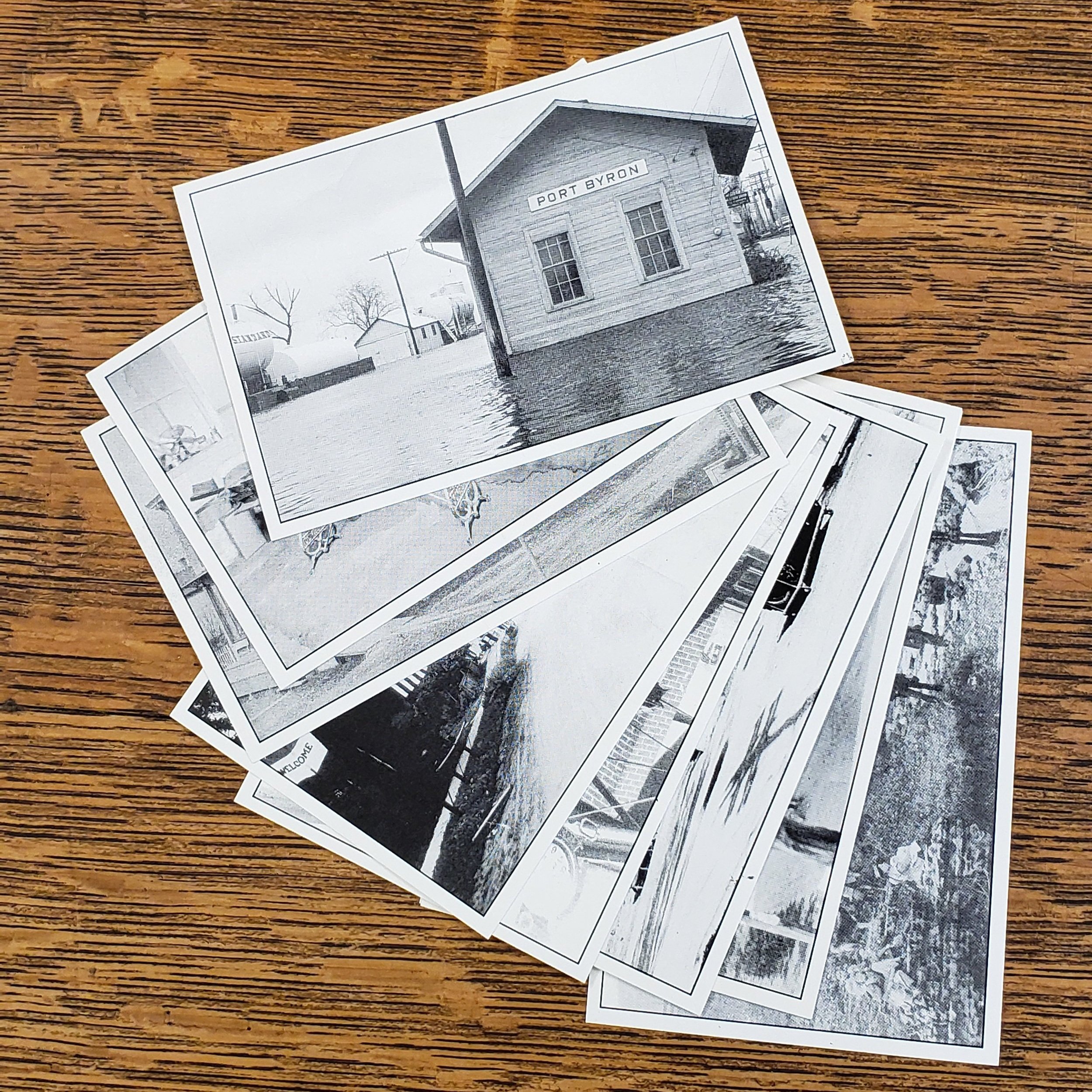
Although local residents tried to bring the railroads to Port Byron in the 1850s, the Mississippi River connected the village to the region well into the 20th century. From 1908 to 1925, Martin and Ben Lamb operated a ferry, the Dolphin between Port Byron and Le Claire. When the river was frozen, during the winter months, folks in both towns used what they called “the ice bridge.” Around 1910, the ferry’s schedule coincided with the Davenport-Clinton Interurban (electric train) schedule. The same schedules coincided for the return trip. The railroad did come to Port Byron in 1861 with the Warsaw, Rock Island & Galena Railroad and the Sterling Rock Island Railroad, and in 1866 via the Western Union Railroad. Port Byron was the terminus for both railroads. They were joined in the 1870s as the Western Union Railroad, serving North Rock Island County. It later became the Milwaukee Railroad.